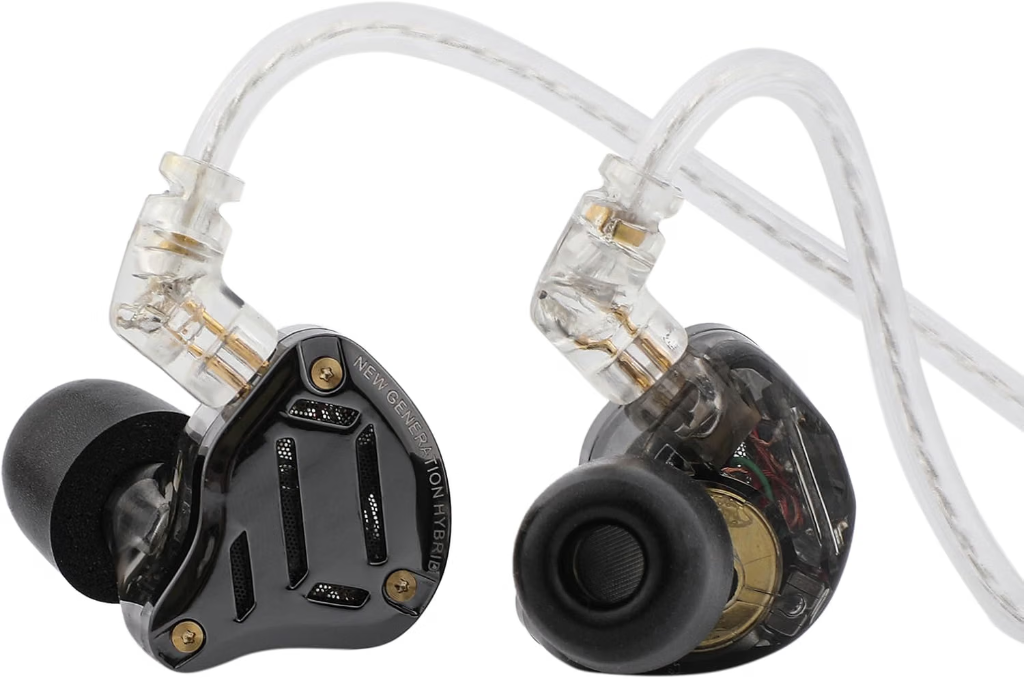
Why in-ears took over the competitive field
Walk behind a stage at a Counter-Strike event and the players are wearing
in-ears under their headsets. Two reasons.
The first is isolation. A properly sealed in-ear blocks the room mechanically —
crowd, commentary, the other team — better than almost any closed-back headphone.
That was originally about a stage, but it applies equally to a shared flat.
The second is imaging. The drivers sit at the entrance to your ear canal with
nothing between them and your eardrum, and the room contributes nothing. Left is
left, and quiet detail stays audible without turning the volume up.
Both advantages depend entirely on a seal, which is where most listeners go
wrong.
Fit is the specification
If you take one thing from this page: an in-ear that does not seal is not a
worse version of itself, it is a different product.
Without a seal you lose the entire low end, isolation drops to nothing, and the
imaging shifts as one side leaks more than the other. People conclude the set is
thin and bass-light when they are simply not hearing what was designed.
Most sets ship with three tip sizes and the assumption that one fits. Ears are
not symmetrical, and it is common to want different sizes left and right. Foam
tips expand to fill the canal and seal more reliably at some cost in treble air;
silicone is faster to fit and easier to clean.
Budget both time and a few euros for tips. It changes more than moving a price
bracket does.
Driver counts, and what they actually mean
Listings lead with driver architecture because it is a number that can go up.
A dynamic driver is a miniature loudspeaker: a diaphragm moved by a coil. It
handles low frequencies well because it can move air.
A balanced armature is a tiny, fast mechanism originally built for hearing
aids. It is precise and efficient through the midrange and treble and produces
almost no bass on its own.
A hybrid combines them, with a crossover splitting the signal so each driver
covers what it is good at.
Here is the part the specification does not tell you: every added driver is
another crossover point, and every crossover point is somewhere the sound can go
wrong. A quad-driver hybrid that is blended badly sounds disjointed — a hollow
midrange, a treble that arrives from somewhere else. A single well-tuned dynamic
driver sounds coherent.
More drivers means more potential and more ways to fail. Judge the tuning, not
the count.
The microphone nobody mentions
This is the practical trap, and it catches people every time.
In-ear monitors are audio products from the musician world. They are output
devices. The overwhelming majority ship with no microphone at all, and nothing in
the listing says so, because to the audience they were built for it would be a
strange thing to mention.
You have three ways out:
A desk microphone gives the best voice quality by a distance and costs desk
space and money.
A clip-on boom or lavalier attaches to the cable or your collar. Cheap, and
better than most headset microphones because it sits close to your mouth.
An in-line microphone cable replaces the stock cable with one containing a
small mic. Convenient, always positioned badly, and it hears your keyboard.
Decide which before you order, so the IEMs are not sitting on your desk unusable
while you wait for a second parcel.
Cable noise, briefly
A cable brushing your shirt transmits sound straight up into your ears. It is
called microphonics and it is maddening once you notice it.
The fix is the reason IEM cables curl at the top: worn over the ear, the cable is
anchored and the noise mostly disappears. Almost all competitive-oriented sets
are designed to be worn this way.
What we would ignore
Driver counts as a headline. Covered above.
Frequency ranges spanning 5 Hz to 40 kHz. You cannot hear either end.
Gaming branding on an audio product. The tuning either suits you or it does
not, and a logo does not tell you which.
Wireless in-ears for competitive play. Bluetooth latency is real and audible,
and this is one place where a cable costs you nothing.
 GEAR
GEAR